When it comes to rooftop solar panels, heat is the enemy. While solar panels need sunlight to generate electricity, the heat that comes with it actually reduces their performance.
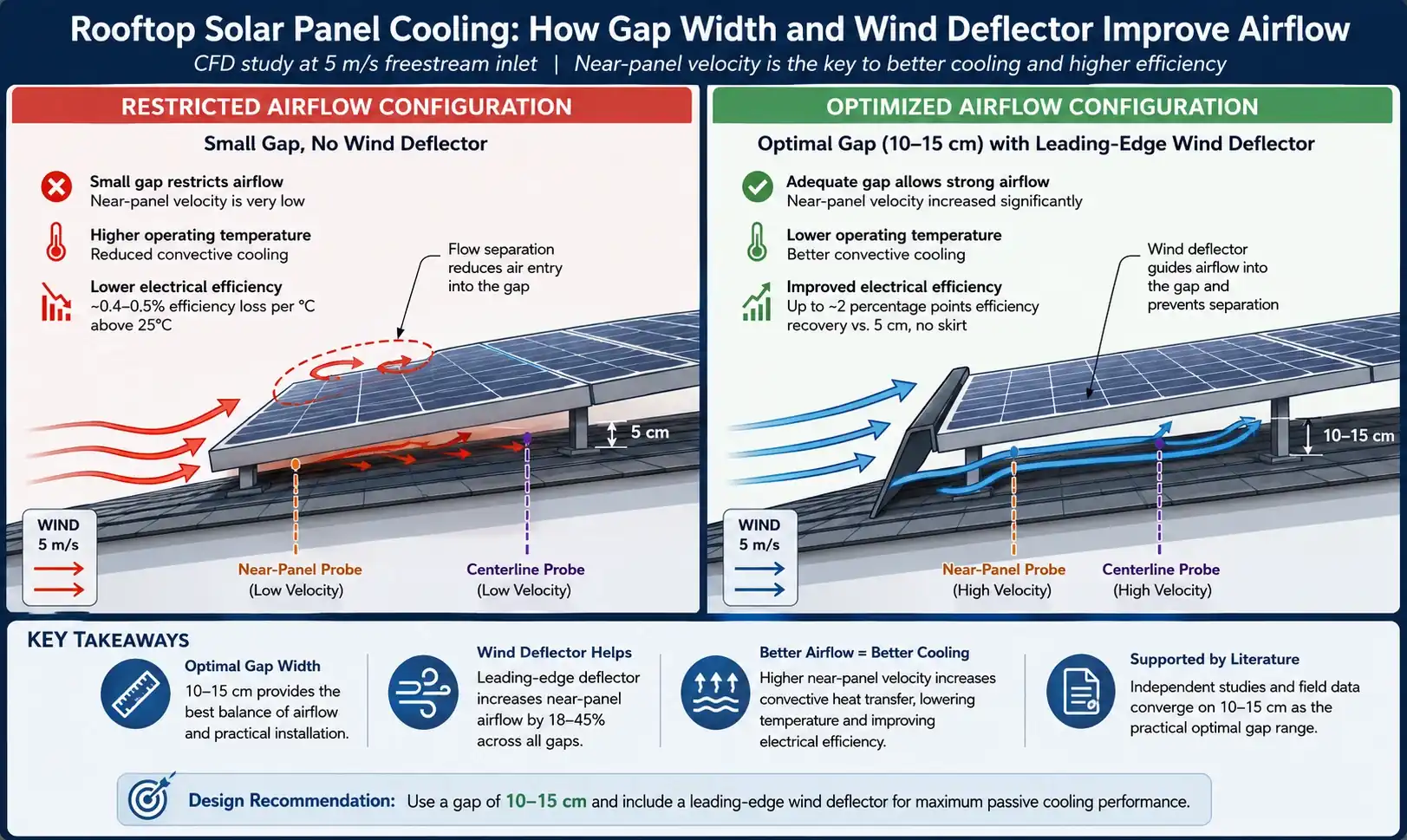
For standard silicon solar panels, electrical efficiency drops by about 0.4% to 0.5% for every degree Celsius they rise above their ideal testing temperature of 25°C (77°F). On a sunny day, rooftop panels can easily bake at 55°C to 75°C, leading to massive power losses.
So, how can we keep rooftop solar panels cool without spending extra money on active cooling systems?
The answer lies in passive cooling—using the natural wind to carry heat away from the underside of the panels. A recent Computational Fluid Dynamics (CFD) study by Polar Dynamix investigated exactly how installation geometry impacts this airflow. Here is what we found about maximizing solar efficiency using gap width and wind deflectors
The ‘Sweet Spot’ for Roof Clearances: 10 to 15 cm
When installing solar panels, the gap between the roof and the bottom of the panel acts like a wind tunnel. The speed of the air moving through this tunnel directly controls how well the panel cools down.
Using advanced 2D CFD simulations via AirSketcher, the Polar Dynamix team tested gap widths ranging from 5 cm to 25 cm at a wind speed of 5 m/s.
We discovered a massive, non-linear jump in airflow velocity between the 10 cm and 15 cm marks.
- Below 10 cm: The gap is too tight. Airflow faces high resistance and struggles to push through, leading to poor cooling.
- The 15 cm Jump: Moving from a 10 cm gap to a 15 cm gap increases near-panel airflow by a staggering 245% (from 0.31 m/s to 1.07 m/s). The airflow shifts from being choked by friction to flowing freely.
- Above 15 cm: Widening the gap beyond 15 cm offers very little extra cooling, but it dramatically increases the risk of wind damage (wind-loading) to the mounting structure.
The Takeaway: For the best balance of thermal cooling and structural safety, solar installers should aim to mount panels with a 10 cm to 15 cm (4 to 6 inches) gap off the roof surface.
Do Wind Deflectors (Skirts) Help or Hurt
There is a common myth in the solar industry that front wind deflectors—often called skirts—block the wind and make panels hotter. Our research proves the exact opposite is true for leading-edge deflectors.
When wind hits the sharp, blunt front edge of a solar array, it creates a “separation bubble”—a chaotic swirl of dead air that actually prevents smooth airflow from getting under the panels.
By adding a properly angled leading-edge wind deflector, you eliminate this bubble. The deflector scoops the incoming wind and guides it smoothly into the gap.
Our simulations showed that adding a front wind deflector boosts under-panel airflow by 18% to 45%. The biggest benefit was seen at the tighter 10 cm gap, where the deflector increased wind speed by a full 45%.
Conclusion: Smarter Installations Mean More Power
You don’t need expensive technology to improve the output of a rooftop solar array. By simply optimizing the physical mounting setup, installers and system owners can unlock free performance gains.
Best Practices for Rooftop Solar Installations:
- Elevate the Panels: Ensure a gap of 10 to 15 cm between the roof and the panels to allow for maximum convective cooling.
- Use Front Deflectors: Install leading-edge wind deflectors to funnel air under the array and increase cooling wind speeds by up to 45%.
By paying attention to these simple aerodynamic principles, we can lower solar panel temperatures, reduce thermal degradation, and generate more clean energy year-round.
Looking for deeper engineering insights? The full technical findings are detailed in the Polar Dynamix study: “Effect of Gap Width and Wind Deflector on Near-Panel Airflow Velocity in Rooftop Photovoltaic Channels: Implications for Convective Cooling and Electrical Efficiency – A 2D CFD Study“
About Polar Dynamix
Polar Dynamix is a technology company dedicated to bridging the gap between complex engineering simulations and intuitive design. Through our specialized 2D Computational Fluid Dynamics (CFD) tool, AirSketcher, we empower professionals, educators and students to visually conceptualize fluid dynamics and develop energy-efficient, sustainable solutions for the future.